Unlock numerous job opportunities such as Data Scientist, Data architect, Cloud & Cybersecurity project manager, and more. The program is dedicated to give the best expertise from both international academic & professional perspective.
A Master in Computer Science can open doors to many new and exciting jobs.
Take your education one step further with the online Master of Science in Artificial Intelligence and Big Data and get the best possible preparation to access bottleneck professions that are in high demand.
eBIHAR curriculum is structured around four main blocks of professional IT skills :
Big Data Engineering : collection, processing, storage and utilisation of large volumes of data in Big Data environments.
Artificial Intelligence Engineering : design and implementation of AI solutions based, in particular, on machine learning and deep learning.
Full-Stack Application Development : development of web and mobile applications incorporating artificial intelligence technologies.
Cloud Architectures & Cybersecurity
This online course from the Ecole Supérieure des Technologies Industrielles Avancées (ESTIA) is done in partnership with Datum Academy, France Université Numérique (FUN), Oracle University, and Google Cloud.
The training enables you to acquire the theoretical and practical skills companies, learn more about Artificial Intelligence and Big Data through academic and Big Data through academic concepts and methods to industrial tools.
An internship is mandatory: an assignment in a company must be at least 4 months long. It can start between the beginning of April and the end of June. The oral defense will take place towards the end of September. A minimum 4-month mission in a company/research laboratory must be validated, the type of contract is not important. A report is also required on this project.
COURSES
The MSc eBIHAR comprises 13 academic modules taught by lecturers from the ESTIA engineering school. Each academic module is divided into 6 or 7 units, each of which is taught over the course of a week (≈ 5 hours of study per week).
All academic courses are offered as MOOC videos, giving you complete flexibility in your learning journey.
Academic courses are delivered on the Moodle platform. You will find instructional videos, downloadable course materials and detailed case studies. This format is designed to help you easily grasp the concepts and apply them in real-world projects.
BLOCK 1 : (BIG) DATA ENGINEERING
Big Data SQL (⌛ 30 hours) :
Module 1 : Big Data paradigms and Codd's relational model
Module 2 : Introduction to SQL2
Module 3 : Chris Date and Mike Stonebraker's manifestos on the object-relational model
Module 4 : Introduction to ODMG and OQL
Module 5 : Introduction to SQL3
Module 6 : NoSQL and NewSQL
Module 7 : SQL and vector databases
Object-relational, OQL (ODMG) and Oracle SQL3 (⌛ 30 hours) :
Module 1 : Introduction, base types and abstract types
Module 2 : Identity and collections in Oracle SQL3
Module 3 : Object tables and association links
Module 4 : Inheritance and object mapping of SQL2 relational tables through views
Module 5 : Managing large objects
Module 6 : PL/SQL extended to complex objects and object-relational mapping in Java/JDBC
NoSQL and data lakes (⌛ 30 hours) :
Module 1 : Recap of Big Data concepts and NoSQL databases
Module 2 : Introduction to Oracle NoSQL
Module 3 : Oracle NoSQL and the key/document model
Module 4 : Introduction to MongoDB and MongoShell
Module 5 : Introduction to MongoDB and its Java API
Module 6 : Big Data architectures and building data lakes with Big Data SQL
Distributed Big Data management (⌛ 30 hours) :
Module 1 : Big Data and AI concepts
Module 2 : Disruptive concepts in the data economy
Module 3 : NoSQL and vector databases
Module 4 : Map/Reduce
Module 5 : Hadoop
Module 6 : Advanced Hadoop and Spark
Big Data administration with Oracle (⌛ 30 hours) :
Chris Date and Mike Stonebraker's Manifestations on the object relational model
Data and Codd Relational Model for structured databases
Data and NO SQL paradigms for unstructured databases (Datalakes and polystores)
OQL for object databases
SQL2 for Relational Databases
SQL3 for hybrid (object-relational) databases
Basics of Machine Learning
Computer Vision, Natural Language
Learning with Deep Architectures
Learning with Shallow Architectures
Mathematical Tools
Software Packages for Machine Learning
Angular
Fullstack & PWA
Grails Framework
Groovy & Grails basics
REST API
Spring security
Web mobile & responsive
Advanced Hadoop development Apache Spark
Category theory
Graph query languages
N.O. SQL and NEW SQL
Strategic vision on big data economy around technical disruptions
The map/reduce paradigm Hadoop presentation
Asymmetric Cryptography
Attacks & malware
Mandatory Access Control
Security policy & mechanisms
Symmetric Cryptography
Users authentification & network security
Vulnerability and privilege
Designing NFC use cases
Introduction to the NFC standard
NFC secure card emulation mode ecosystem and architecture
Programming NFC applications with Android
Agile project management
Tools & Agile management
Automation et pipeline
AWS/GCP storage and database
Cloud programming introduction
Demystify the Cloud architecture and introduction to AWS and its basics
DNS, content delivery, containers, serverless programming and application integration
EC2/GCE
Automation et pipeline
AWS/GCP storage and database
Cloud programming introduction
Demystify the Cloud architecture and introduction to AWS and its basics
DNS, content delivery, containers, serverless programming and application integration
EC2/GCE
Java & Kotlin Languages
Android SDK
Flutter Framework
IOS Framework
Objective-C & Swift Languages
Project (Buy & Sell Application)
Project (Buy & Sell Application)
Blockchain
Smart contract & Ethereum
Create procedures, functions, packages, and triggers using PL/SQL
Create projects, workspaces, SQL scripts, job schedules, templates, and notebooks in OML
Describe OML use cases
Describe the components and feature of Oracle Machine Learning (OML)
Identify Oracle Cloud Services that are compatible with OML
Program with Oracle SQL and PL/SQL
Use OML features with Oracle Autonomous Database
ADMISSIONS
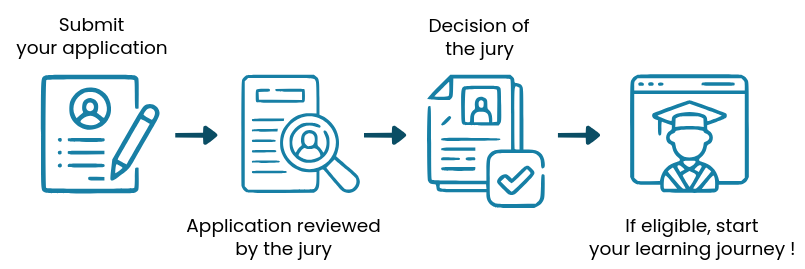
The application process is really simple. A panel will meet to review all admissions to determine whether or not an applicant is eligible for the program. An answer regarding this deliberation will be sent to you by email whether you are selected or not. Selected candidates can block their seats through the payment of the admission fee.
FEES
A non-refundable application fee of 50 € must be paid when submitting an application to the Master's program.
The 7000 € program enrollment fee may be paid in three or four installments. If you are a student in a Connected Digital Campus (CDC), the specific fees for this program should be checked with your university. All fees mentionned are with the tax included.
Full Payment
7000 €
1st Month
2nd Month
3rd Month
2334 €
2333 €
2333 €
1st Month
2nd Month
3rd Month
4th Month
1750 €
1750 €
1750 €
1750 €
KEY BENEFITS
Obtaining a 1 year European MS degree in Computer Science based upon MOOCs
Getting a complete European/accredited Master degree in Artificial Intelligence and Big Data (90 ECTS)
Giving you the best expertise from both international academic and professional perspective
Learning 4 key jobs in the Data Economy : Big Data Architect, Data Scientist, Cloud and Cybersecurity Project Manager, and Mobile/Web Developer
Accessing Oracle exclusive courseware and lab environments that provide real world training on Oracle Cloud
Employees may be eligible to receive financial aid from their employer.
To submit an application, you must first create an account on our site by clicking on the button Enroll Now. After creating your account, you will be automatically redirected to a page that will allow you to fill in all the information required for your application. You will always be able to return to this file by logging into your account by clicking on the Login button.
To be eligible, you must have a Master 1 or a 4-year Bachelor degree in Computer Science. Candidates with a Master's degree in another field will unfortunately not be considered as eligible, as the training requires extensive knowledge acquired during the previous year in computer science.
Once you have submitted your application on our website, a panel of judges will meet to evaluate your application. You will receive an answer by email, whether positive or negative. If it is positive, you will receive a link to pay your tuition. Once the payment is confirmed, you will receive a confirmation by email within 48 hours, as well as your access to the learning platforms. Your schooling certificate will be sent a few days later by ESTIA.
The online program might be seen more difficult than the residential one as students should demonstrate learning autonomy. For a university course each weekly module (1 or 2 hours on line) requires 5 hours of student work which could lead to 10 hours student activity per week for 2 courses.
Of course! All our courses, including the MSc eBIHAR, are open to everyone, regardless of your nationality or place of residence. This is the magic of distance learning :)
You could ask for a course transfer (needs justification) on your application form or submit your Oracle certificate if you have it. If you are in this situation, please contact us !
You only need a computer and an internet connection.
If you choose to pay in 3 installments, you will be charged once a month on the same day starting with the first payment. For example: if you make your first payment on September 1st, you will be debited on October 1st for the second payment and on November 1st for the third payment.
Every MOOC module is tutored both in P2P mode in the social network of students (within FUN MOOC platform) and with a weekly video chat of 2 hours with the professor in charge of the course. On the Oracle University platform, you can contact your instructor through the tool « Ask instructor » on your course page. And of course, Datum Academy staff is always available to help you through your training !
The diploma will not be marked "online" since both diplomas (online and face-to-face) have exactly the same value in terms of teaching and ECTS delivered.
Don't worry we won't spam you ! You'll only receive one mail per month.
Sorry, something went wrong. Please try again later.
DATUM ACADEMY NEWSLETTER
Thank you for your interest! Almost done!
We value your privacy and therefore we have send you an email to ask for your
permission in order to finalize your newsletter subscription.
We value your privacy!
In order to function properly, our website uses cookies. We process personal data such as IP addresses and cookie identifiers for security reasons but also to understand how you interact with our website and improve your user experience. To continue, we need your agreement by clicking on the button below.